
6 min read · August 14, 2026
Mindfulness for Exam Stress: What to Do When You Can't Make Yourself Start
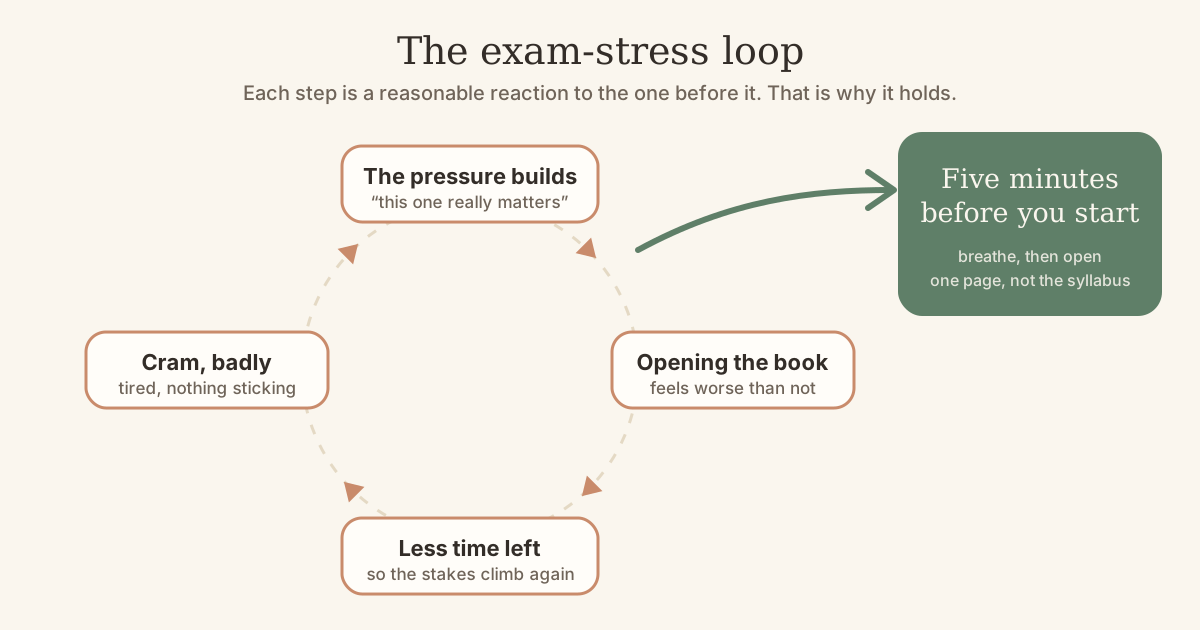
There's a particular kind of afternoon that anyone who has sat a serious exam will recognise. You have known for weeks what you need to do. You have the books. You have the hours, technically. And you spend the entire day not starting — cleaning something, reorganising your notes, watching one more video about how to study — while a low hum of dread runs underneath all of it.
Everyone around you will diagnose this as laziness, including you. It almost never is. It's an anxiety loop, and it has a shape.
The loop, and why it holds
The stakes feel enormous, so opening the book means confronting how much you don't know yet. That confrontation is genuinely unpleasant, so you postpone it — which is the single most effective way to make the unpleasant feeling stop, right now. But postponing eats the time you had, which raises the stakes further, which makes opening the book even more unpleasant tomorrow.
Every step in that chain is a completely reasonable response to the step before it. That's exactly why willpower alone rarely breaks it: you're not fighting a character flaw, you're fighting a system that is, in the short term, working perfectly. Avoidance always pays out immediately. Studying pays out in three weeks.
So the useful move isn't to try harder. It's to make starting cost less.
Five minutes before you study
Not five minutes of meditation for its own sake — five minutes engineered to lower the price of beginning.
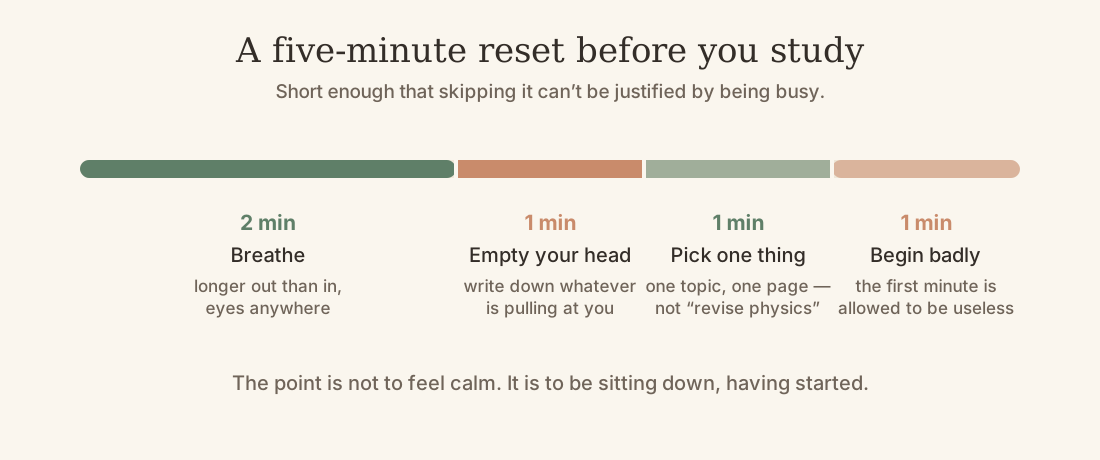
Two minutes of breathing with the out-breath longer than the in-breath, to take the physical edge off. One minute writing down whatever's pulling at your attention — the argument, the message you haven't answered, the other subject you're behind on — so it isn't competing for space. One minute choosing one genuinely small thing: not "revise physics" but "read these four pages" or "redo question 3." And one minute actually beginning, with explicit permission for that first minute to be useless.
That last permission matters more than it sounds. Most stalling happens because you're trying to start well — with the perfect plan, at full concentration, in the right mood. Starting badly is available immediately, and it is the only version that ever leads to starting properly.
Study in blocks small enough to be un-scary
Twenty-five or thirty minutes, then a real break away from the desk. The specific number matters less than the fact that the block has an end you can see from the beginning. "Study until you've finished" is an infinite task, and the mind refuses infinite tasks. "Study until 4:30" is a finite one it will usually accept.
Use the breaks properly: stand up, look out of a window, walk to another room, get water. Scrolling is not a break — it's a different kind of input, and you'll come back more scattered than you left. Two minutes of doing nothing feels wasteful and is worth far more than five minutes on your phone.
The thoughts that show up while you study
"I'm going to fail." "Everyone else has finished the syllabus." "I should have started in June." These will arrive regardless of how well your session is going, and arguing with them is a trap — it takes ten minutes and you never win, because they aren't arguments, they're weather.
The mindfulness move here is small and slightly unsatisfying: notice the thought, name it as a thought rather than a fact — "there's the failing one again" — and return to the sentence you were reading. You'll do this thirty times an hour at first. The returning is the skill; the noticing isn't a failure of concentration but the beginning of it.
It also helps to know that comparison is almost entirely noise. Everyone reports their study hours the way people report their salaries: inaccurately, and in whichever direction makes the conversation go better. The person who says they've finished three revisions has usually skimmed one.
In the exam hall itself
If your mind goes blank when you turn the paper over, that is not the end of the exam — it's a stress response, and it passes on a timescale of seconds if you let it. Put the pen down. Feel your feet on the floor. Take one slow breath with a long exhale. Then read one question, all the way through, without deciding whether you can answer it.
Start with a question you know. There's no prize for going in order, and the fastest way to bring recall back online is to demonstrate to yourself that recall exists.
The part that's worth saying plainly
In a lot of places — and India is very much one of them — an exam is not treated as a test but as a verdict on your entire future, delivered publicly, with your family watching. That pressure is real and it isn't in your head. None of the above dissolves it.
What's also true, and much harder to hold onto at seventeen, is that a result is a piece of information about one morning, not a measurement of your worth. Nearly every adult you'll meet has a story about a door that didn't open and the one that did instead. If the weight of it is getting to the point where you can't eat, can't sleep, or find yourself thinking that not being here would be simpler, please tell someone — a parent, a teacher, a friend, a helpline. That is not an overreaction, and it is not a weakness. It is the single most sensible thing you can do with a feeling that big.
Reauris writes about mental wellness for a general audience. Nothing here is medical advice, a diagnosis, or a substitute for care from a qualified professional. If something in your life feels bigger than an article can hold, talking to a doctor, a therapist, or a helpline is a genuinely good next step.