
6 min read · August 14, 2026
Breathing Exercises for Anxiety: Why the Out-Breath Is the One That Matters
"Just take a deep breath" might be the least helpful sentence in the English language. It's what people say when they've run out of things to say, and when you're already anxious it lands as an instruction to perform calmness you don't feel. Worse, taken literally, it's often the wrong move: a big, sharp inhale is the shape of a gasp, and gasping is what a startled body already does.
There is something real underneath the cliché, though. It's just not the deep part that matters. It's the long, slow, unhurried out-breath.
Why breathing does anything at all
Almost everything your body does when it's stressed is out of your reach. You can't decide to lower your heart rate, unclench your stomach, or stop the adrenaline. Breathing is the strange exception — the one process that runs automatically but that you can also take over by hand. It's the only obvious control on the outside of a system that's otherwise sealed.
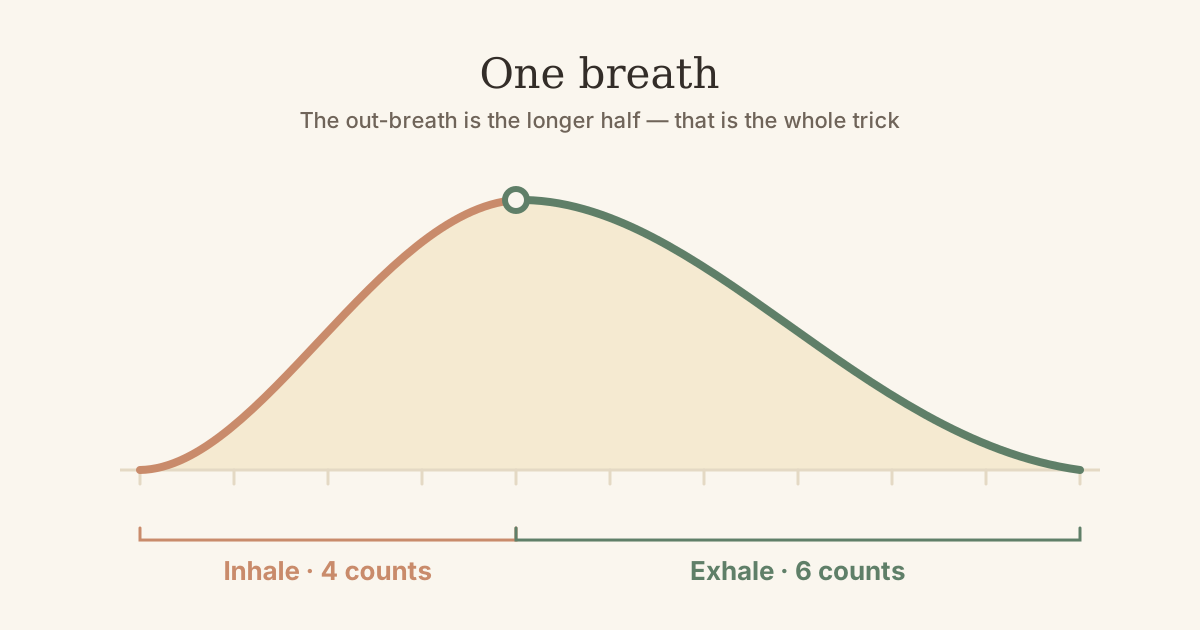
And here's the useful asymmetry: breathing in and breathing out don't have the same effect. When you inhale, your heart speeds up very slightly. When you exhale, it slows. You can feel this if you sit quietly with a hand on your chest for a minute. So the lever isn't "breathe more." The lever is "make the out-breath longer than the in-breath." Everything below is a variation on that one idea.
The simplest version: in for four, out for six
Breathe in through your nose for a slow count of four. Breathe out through your mouth, softly, for a count of six. Don't force the lungs full and don't squeeze them empty — you're not trying to maximise anything, just to spend more time on the way out than the way in. Do it six or eight times.
If four and six feel like a stretch, use three and five. If you're very worked up, start with whatever ratio you can actually manage and lengthen it as it gets easier. A shaky, uneven 3-and-4 that you actually do beats a perfect 4-and-6 that you abandon after two rounds because it feels like being underwater.
You'll usually notice something within a minute or so. It won't be the feeling going away. It's more that the physical urgency comes down a notch — the tight-chested, hunted quality softens slightly, and thinking becomes possible again. That's what this is for. It's not a cure, it's getting the floor back under you.
When you need something to hold on to: box breathing
Some people find an open-ended "breathe slowly" impossible when anxious, because the mind keeps wandering back to whatever it's chewing on. Box breathing gives it a structure to walk around instead — four equal sides, each a count of four.
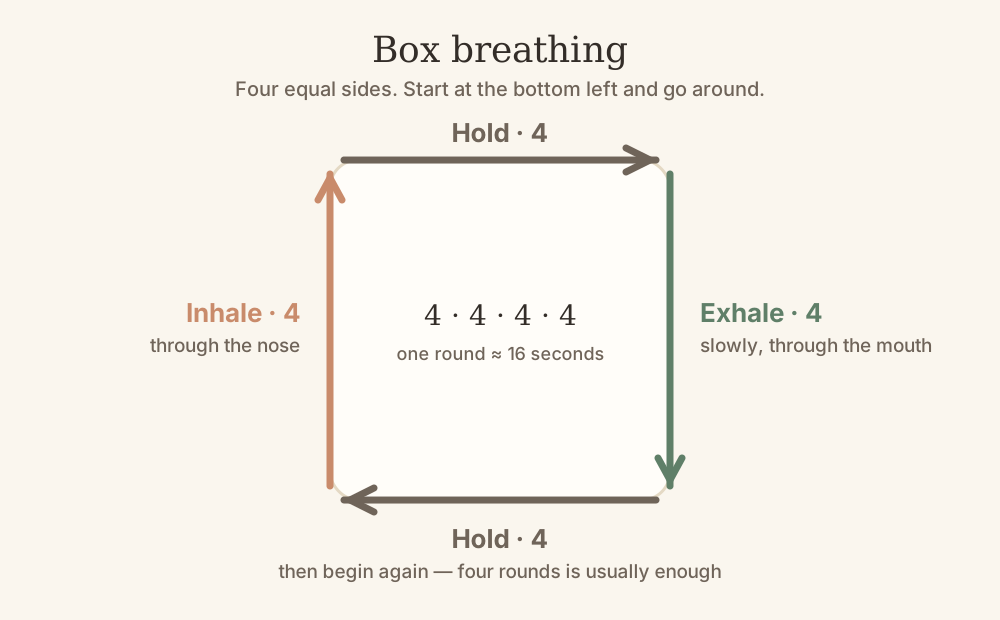
The holds are what make this one polarising. For some people they add a satisfying sense of control. For others — particularly anyone whose anxiety shows up as breathlessness — holding a breath is exactly the wrong sensation and makes things worse. Both reactions are normal. If it's the second one, skip this exercise entirely; there's nothing you're failing at.
The one that works fastest: a double inhale, then a long sigh
This is the pattern your body does on its own after you've been crying, or when you're falling asleep — two inhales through the nose, the second one shorter and stacked on top of the first, followed by a long, unhurried exhale through the mouth. It's often called a physiological sigh, and it's the one to reach for when you need something in seconds rather than minutes.
The reason it's so quick is that you're not overriding your body so much as deliberately triggering something it already does to reset itself. One or two rounds is often enough to take the edge off. It's also the most discreet of these — you can do it standing in a corridor before a meeting and nobody will notice.
When breathing exercises make it worse
This part gets left out of most articles, and leaving it out does real harm. For a meaningful number of people — especially those who've had panic attacks, or whose anxiety is tangled up with a past trauma — turning attention onto the breath is unpleasant rather than calming. Watching your breathing can make you feel like you've forgotten how to do it, or make you newly aware of a tightness you'd been ignoring, and the loop tightens instead of loosening.
If that's you, you're not doing it wrong and you don't need to push through. Attention just needs somewhere else to go — outward instead of inward. Naming what's in the room, pressing your feet into the floor, running your hands under cold water, or holding something with a strong texture will do the same job without asking you to monitor your own body.
Practising when you're fine is what makes it work when you're not
The catch with all of this is that a breathing exercise you've only ever read about is very hard to remember mid-spiral. The moment you need it most is the moment you have the least access to new instructions. What actually makes it available is having done it a few times when nothing was wrong — waiting for a kettle, sitting in traffic, lying in bed before sleep — until the pattern is something your body recognises rather than something you have to reconstruct from memory.
Two minutes, a few times a week, is enough to build that. This isn't a practice you need to be good at. You only need to have done it before.
If you want to try one now rather than later, the "Take a Breath" button in the corner of this page opens a sixty-second guided round — a slow shape to follow so you don't have to count anything yourself.
Reauris writes about mental wellness for a general audience. Nothing here is medical advice, a diagnosis, or a substitute for care from a qualified professional. If something in your life feels bigger than an article can hold, talking to a doctor, a therapist, or a helpline is a genuinely good next step.