
6 min read · August 14, 2026
Why Your Mind Races at Night (and What Actually Helps)

You got through the whole day. Work, messages, dinner, the small administrative indignities of being a person. Then you turn the light off, and within ninety seconds your mind produces a complete, itemised list of everything unresolved in your life — including two things from 2019 you had genuinely forgotten about.
This is so common that it's almost the default human experience of bedtime. And it's not a sign that something is wrong with you. It's a fairly predictable consequence of what nighttime actually is.
Nothing is competing for your attention anymore
All day, your attention has somewhere to be. There's a screen, a conversation, a task, a queue, a notification. None of it is restful, exactly, but it is occupying. The thoughts that are waiting for you don't disappear during all that — they just can't get a word in.
Lying in the dark is the first moment in about sixteen hours with no input at all. No light, no sound, no task. Your mind doesn't experience that as peace; it experiences it as free capacity. And it fills the capacity with the things it has been trying to hand you all day.
There's a second thing going on too. Overnight is the one stretch where you can't do anything about any of it. You can't send the email at 11:40pm, can't call the clinic, can't have the conversation. Worry is, at its root, a problem-solving instinct — and a problem-solving instinct with no available action just runs in place, loudly.
Why "stop thinking about it" never works
Because instructing yourself not to think about something requires you to keep checking whether you're thinking about it, which means thinking about it. Trying to force the mind quiet turns bedtime into a performance review you're failing in real time — now you're not only worried, you're worried about being awake, and doing the arithmetic about how many hours are left.
What tends to work better is the opposite move: give the thoughts somewhere to be, rather than trying to make them stop.
Write it down before you get into bed
The most reliable thing here is almost stupidly simple. Ten or fifteen minutes before bed, sit somewhere that isn't your bed with a notebook and empty your head onto the page. Not a journal, not reflection — a list. Everything unfinished, everything you're dreading, anything you're afraid of forgetting. Beside anything actionable, write the next single step and, if you can, when you'll do it.
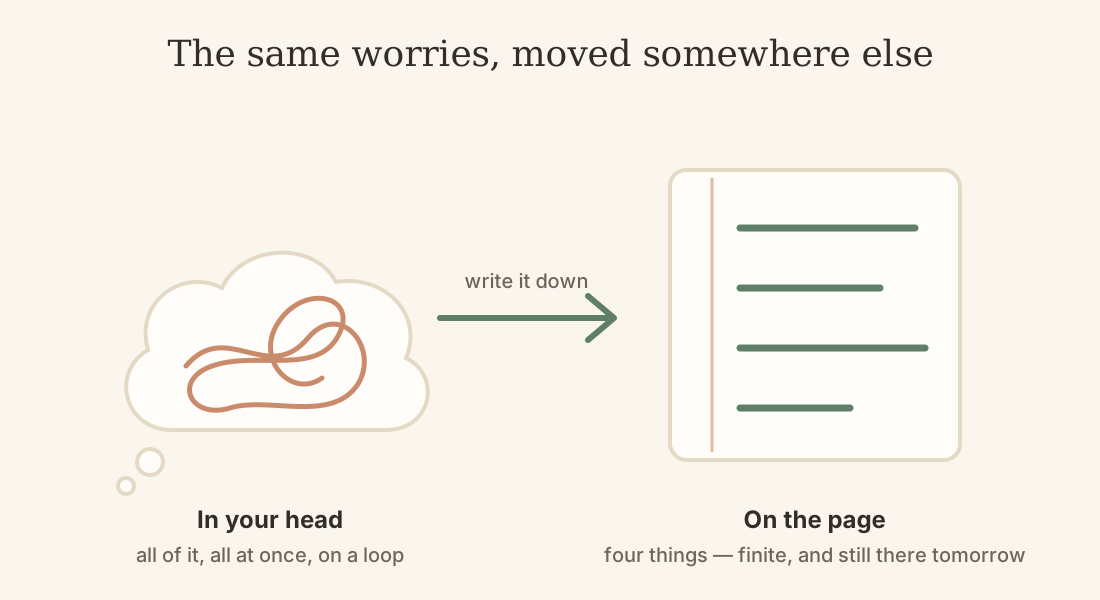
The reason this helps isn't mystical. A large part of what keeps you up is the mind's fear of losing track of something important — so it keeps re-presenting the list to make sure you've still got it. Writing it down is a credible promise that the list will survive the night without you holding it. Quite often you'll also find that the terrifying, shapeless mass turns out to be four ordinary items, two of which aren't yours to solve.
Do this before bed rather than in bed. The point is partly to keep the bed a place where thinking doesn't happen.
If you're already lying there
Get up. This is counterintuitive and everyone hates it, but staying in bed while your mind sprints teaches your body that bed is where sprinting happens. After twenty minutes or so of clearly not sleeping, go to another room, keep the lights low, and do something undemanding and boring — a few pages of a book you've read before, not a screen. Go back when you feel heavy. It'll cost you a little sleep tonight and pay you back over the next few weeks.
If getting up isn't realistic, give your attention a slow, dull task instead of a fight. Lengthen your out-breath so it's longer than your in-breath and count the exhales backwards from twenty. Or work slowly through your body from your feet to your jaw, unclenching whatever you find. Neither of these is a sleeping pill. What they do is occupy the part of your mind that would otherwise be composing tomorrow's disasters.
The things that matter more than any technique
Two boring habits outperform every clever trick. The first is a consistent wake-up time, including weekends — your body clock is set far more by when light hits your eyes in the morning than by when you got into bed. The second is a real gap between the last screen and the pillow. Not because of blue light particularly, but because scrolling is a stream of small emotional events, and you can't hand your nervous system twenty of those and then ask it to power down in four minutes.
It's also worth knowing that a bad night is not a catastrophe, even though at 3am it feels like one. Humans tolerate broken sleep considerably better than the anxiety about broken sleep suggests. Some of the worst nights are made almost entirely of the fear of the night going badly.
When it's more than a loud evening
If this has been every night for weeks, if you're waking at four and never getting back down, or if the daytime is going grey too, that's worth taking to a doctor rather than managing alone. Persistent insomnia is treatable, and the front-line treatment — CBT-I — is a structured programme with a good track record, not a lecture about camomile tea. Asking about it is a practical move, not a dramatic one.
Reauris writes about mental wellness for a general audience. Nothing here is medical advice, a diagnosis, or a substitute for care from a qualified professional. If something in your life feels bigger than an article can hold, talking to a doctor, a therapist, or a helpline is a genuinely good next step.